
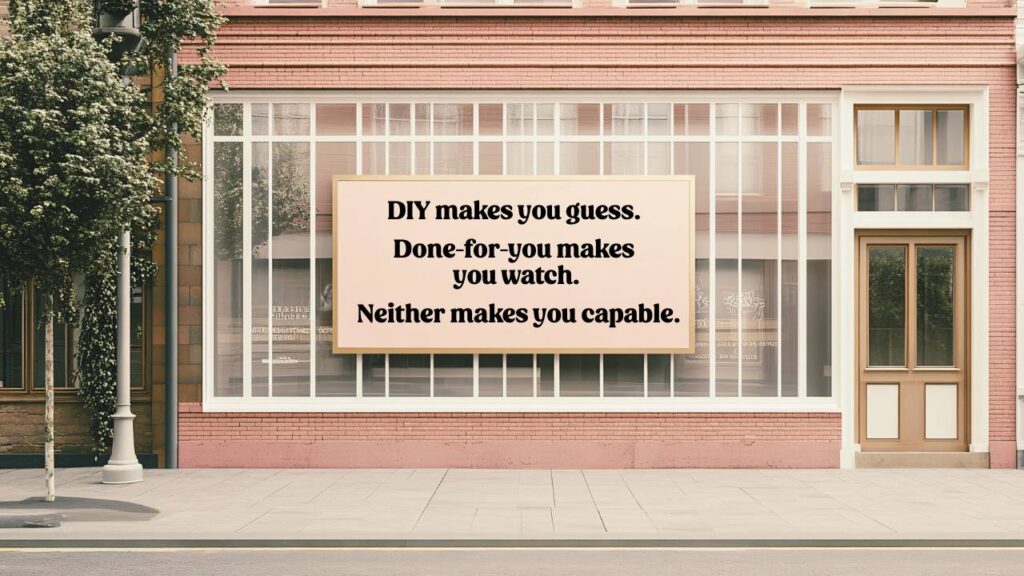
They want to learn, not outsource. That’s the secret your best clients wish you knew: they don’t want you to do it for them, they want you to do it with them.
They don’t want you to do it for them.
They want you to do it with them.
But the done-for-you model is exhausting. You’re constantly chasing clients, battling for results, and feeling the pressure to single-handedly drag projects across the finish line. It’s a recipe for burnout, and it makes you think, “Maybe I should just do it all myself.”
It seems like the logical next step: more control, guaranteed results, and no more chasing people down before you can just do the work.
Done-for-you is a trap, and it’s one that leaves you feeling more burnt out and resentful than ever.
The myth of control
As experts, we love control. We want to control the process, control the outcome, and make sure things are done right.
So the idea of a done-for-you service is incredibly appealing. It’s the ultimate form of control: you call the shots, you do the work, you get to be the hero.
What you don’t realize is that when you take on all the control, you also take on all the responsibility. That’s a heavy burden to carry alone, week after week, client after client.
The scalability myth of done-for-you
Here’s the big lie about done-for-you: that it’s a more scalable and profitable business model. It isn’t.
Done-for-you is a one-to-one model. You’re trading your time for money, and there are only so many hours in the day. You can only take on so many clients. You can only make so much money.
As you take on more clients, you’ll find yourself stretched thinner and thinner. You’ll work longer hours, feel more stressed, and have less time for the things that actually matter to you.
Three reasons done-for-you is a dead end
- It creates dependency, not empowerment. When you do everything for your clients, you’re not teaching them anything. You’re not empowering them to take control of their own businesses. You’re creating a relationship of dependency, where they need you for every little thing.
- It’s a recipe for burnout. When you’re responsible for everything, you’re the one working late nights and weekends. You’re the one dealing with the stress and the pressure. Eventually, you’re the one who burns out.
- Your best clients don’t actually want it. A Forbes piece on empowering customers puts it plainly: clients who feel genuinely empowered by working with you are far more likely to come back again. Empowerment builds loyalty in a way dependency never does.
The future is collaborative: the “do it with you” model
So what’s the alternative? A “do it with you” model.
A “do it with you” model is a hybrid approach that combines the best of both worlds. You’re still providing your expertise and guidance, but you’re also empowering your clients to do the work themselves. Real transformation happens here, and it happens because your clients learned how to do it, not because you did it for them.
It’s a collaborative approach that creates a partnership between you and your clients. You’re in it together, working toward a common goal. When your clients understand their business better, they make better decisions. They feel more confident, and they’re more likely to stay with you long-term because they’ve invested in their own growth.
This is why understanding how to describe your business clearly matters so much. When your clients can articulate what they do, they own it. They believe in it, and that belief translates into action.
From technician to teacher
It’s time to reframe your role. The team at The Agile Company puts the goal well when they write about coaching yourself out of a job: the point is to work yourself out of the job. That doesn’t mean the work isn’t valuable. It means your client eventually stops needing you for it, and that’s the actual sign you did it right.
Your job isn’t to do the work for your clients. Your job is to teach them how to do the work for themselves. When you approach your business this way, something shifts. You’re no longer solely responsible for their success. They are. You’re still there, guiding them, supporting them, and helping them navigate the process.
This also means feeling confident in what you’re charging. When you stop apologizing for your pricing, your clients stop questioning it. Confidence is contagious, and when you’re confident in your value as a teacher and guide, your clients feel that too.
What to look for in a done-with-you program
If you’re ready to invest in your business, whether that’s marketing, consulting, coaching, or any other service, stop looking for done-for-you. And don’t settle for DIY either.
Look for programs and services that offer the done-with-you model. Here’s what that looks like.
You’re learning, not outsourcing. The program teaches you how to do the work, not just do it for you, and you walk away with actual skills and knowledge.
You have a guide, not a guru. The person or team working with you is there to support and teach, not to be the hero. They’re invested in your growth, not your dependency.
You own the results. Because you’re learning and doing the work alongside your guide, you understand what’s happening well enough to replicate it and scale it yourself.
There’s accountability and partnership. You’re not left alone to figure it out, and you’re not having it done for you. You’re working together toward a common goal.
The relationship doesn’t end when the program does. You’ve been equipped with knowledge and skills that stick with you, so you’re not starting from scratch if you move on.
This is the future of how people want to buy services, training, and coaching. If you’re offering services, it’s also the future of how you should be selling them.
Ready to build a business that scales?
If you’re ready to stop trading your time for money and start building a business that’s both profitable and sustainable, it’s time to embrace the “do it with you” model.
Be the guide, not the guru. That single shift changes how you build offers, how you price them, and how long your clients stick around once they’ve started.
Related reading: If pricing confidence is part of what’s holding your offers back, read Small Business Pricing: Stop Apologizing for What You Charge.
Frequently Asked Questions
What’s the difference between done-for-you and done-with-you services?
Done-for-you means someone else completes the work on your behalf. Done-with-you means you’re guided through doing the work yourself, so you walk away with the skills and understanding, not just the finished result.
Is done-for-you a bad business model?
Not necessarily, but it is a one-to-one model that trades your time for money, which puts a hard ceiling on how much you can scale or earn without working more hours.
Why do clients prefer to learn instead of outsource?
Clients who understand their own business make better decisions and feel more confident in it. That confidence and ownership is what keeps them invested and working with you long-term.
How do I shift from a done-for-you to a done-with-you model?
Start by reframing your role from technician to teacher. Instead of doing the task, guide your client through it, so the value you offer becomes the transformation they can repeat on their own.
Where in your business are you still doing it for clients instead of with them? That’s usually the first offer worth redesigning.